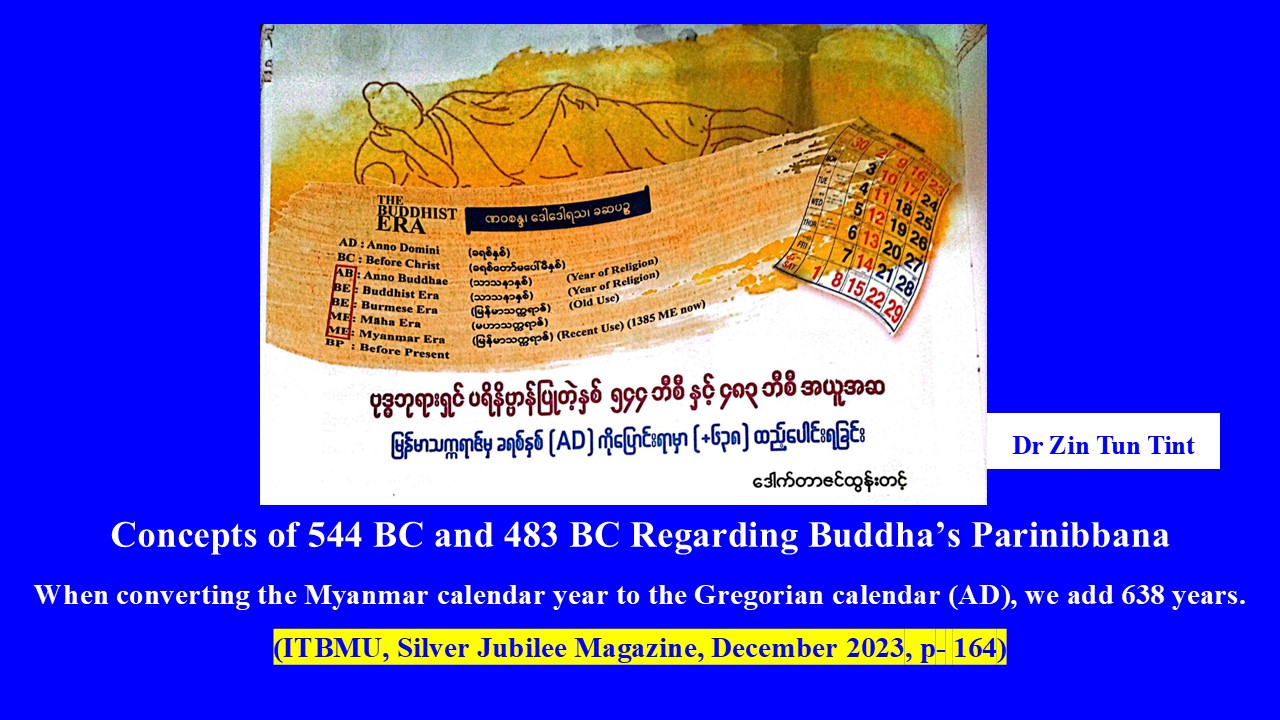
Concepts of 544 BC and 483 BC Regarding Buddha’s Parinibbāna
Concepts of 544 BC and 483 BC Regarding Buddha’s Parinibbāna
When converting the Myanmar calendar year to the Gregorian calendar (AD),
we add 638 years.
(ITBMU, Silver Jubilee Magazine, December 2023, p- 164)
Dr Zin Tun Tint
Historians and educators should be aware of the differing concepts regarding the year of Buddha’s Parinibbana, which are 544 BC and 483 BC, and the process of converting Myanmar Era (Koza Sakarit) (Kawzar) to the Gregorian calendar by adding 638 years. For example, the current Myanmar year 1388 (1388 + 638 = 2026 AD) is equivalent to 2026 AD (2026 – 638 = 1388 ME). The number 638 refers to 638 AD. It is crucial to understand the recalculation of eras such as “Ṇavacanda” (ဏဝစန္ဒ)၊, “Dodorasa” (ဒေါဒေါရသ), and “Khachapañca” (ခဆပဉ္စ).
Era Abbreviations
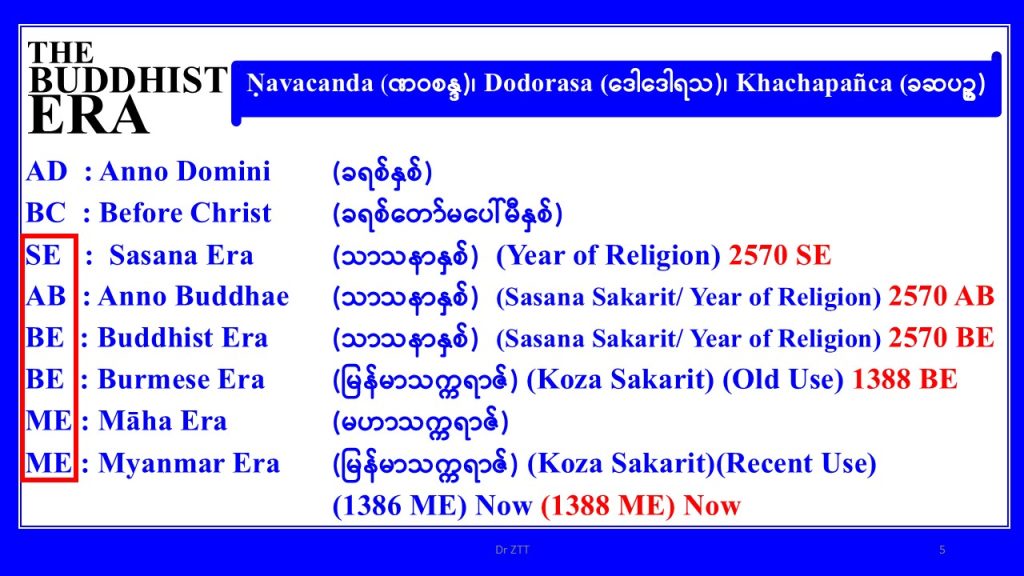
The second point is the confusion among abbreviations for the Mahā Era, Myanmar Era, and others in English, such as ME (Mahā Era), ME (Myanmar Era), BE (Burmese Era), and BE (Buddhist Era). The Mahā Era refers to the period before Buddha’s Parinibbāna, whereas the Sasana Era begins after Buddha’s Parinibbāna. The Mahā Era is abbreviated as ME. The Sasana Era can be referred to as Sasana Sakarit, Year of Religion, Anno Buddhae (AB), or Buddhist Era (BE).
While everyone knows AD (Anno Domini), few are aware of AB (Anno Buddhae), as it is rarely used today. Some mistakenly think AD means “After Death.” AB was used by earlier historians. For instance, AB can be found in the English translation of the Kalyani Stone Inscriptions by Taw Sein Ko published in 1892:
… In 1601, Anno Buddhae, and 419 Sakkarāj, King Anuruddha, the Lord of Arimaddanapura, brought a community of priests together with the Tipitaka (from Rāmaññadesa), and established the Religion in Arimaddanapura, otherwise called Pugāma (Bagan)… (Kalyānī Inscriptions, Trans: Taw Sein Ko, 1892, p- 49)
Transition from Burma to Myanmar
Previously, Burma was the official name of the country, now it is Myanmar. Hence, the Myanmar Era (Koza Sakarit) was abbreviated as BE (Burmese Era) before and is now abbreviated as ME (Myanmar Era). This year is 1388 ME.
In older books and publications from Myanmar, BE was used for Burmese Era, while BE also stands for Buddhist Era. Previously, Mahā Era was abbreviated as ME, but now ME is also used for Myanmar Era. Other Theravada countries and international Buddhist literature use ME for Mahā Era and BE for Buddhist Era. However, in Myanmar, BE can mean both “Buddhist Era” and “Burmese Era,” and ME can mean both “Mahā Era” and “Myanmar Era.”
Therefore, to avoid confusion in academic publications, it is advisable to use full terms instead of abbreviations or to clearly indicate the original meaning of abbreviations.
Key Point
The critical point in this paper is that the year of Buddha’s Parinibbāna is presented as 544 BC. Both Myanmar and other Theravada countries traditionally recognize 544 BC as the year of Buddha’s Parinibbāna. However, Western scholars suggest 483 BC. Thus, there is a 61-years difference between these two recognized dates.
In the book “Political History of the Bagan Period” by Dr. Than Tun, it is stated:
“… the Burmese believe that the Buddhist Era started in 544 BC before the Christian Era. However, historians have revised this to 483 BC. Therefore, when calculating the Buddhist Era in relation to the Christian Era, only 483 BC is used.” (Dr. Than Tun, 2005, p. 1).
In Dr. Than Tun’s book “Kyaw Swar Ta Yar” and the original book by Michael H. Hart titled “A Ranking of the Most Influential Persons in History,” Buddha is recorded as having lived from 563 BC to 483 BC (Dr. Than Tun, 2001, p. 29; Michael H. Hart, 1993, p. 22).
If we use 483 BC to calculate the Buddhist Era, it will completely differ from the current calendars used in Myanmar. According to these calendars, the current year is 2570 in the Buddhist Era, 1388 in the Myanmar Era, and 2026 in the Gregorian calendar.
The easiest way to calculate the Buddhist Era is by using 544 BC. This year being 2026 AD, we get (2026 + 544 = 2570), resulting in the current Buddhist Era (Sasana Era) 2570. The sum of AD and BC years is referred to as BP (Before Present, AD + BC = BP).
If we use 483 BC, we get (2026 + 483 = 2509), resulting in the Buddhist Era (Sasana Era) 2509, which is 61 years short. This raises controversial questions about who would be responsible for correcting the Buddhist Year in the calendars.
Although 544 BC is used for the calculation of Buddha’s death, some foreign records state 477 BC or 487 BC. “The year of the Buddha’s death is still the subject of controversy.”
In the paper “The Day on Which Buddha Died” written by Dr J. F. Fleet in the Journal of the Royal Asiatic Society (JRAS) in 1909, the year of Buddha’s death is given as 483 BC (Dr. J. F. Fleet, JRAS, 1909).
Alexander Cunningham’s “Book of Indian Eras” confirms 544 BC (Alexander Cunningham, 1883, pp. 34-36), while C. Mabel Duff’s “The Chronology of Indian History” suggests 477 BC (C. Mabel Duff, 1972, p. 6).
Regarding the 483 BC issue written by Dr. Fleet in JRAS 1909, there were back-and-forth clarifications and controversies between C. O. Blagden and Dr. Fleet, detailed in JRAS monthly and yearly (C. O. Blagden, J. F. Fleet, JRAS, April 1910, pp. 474-481).
Two years later, in 1911, Taw Sein Ko intervened with clarifications in both JRAS and the Journal of the Burma Research Society (JBRS) (Taw Sein Ko, JBRS, Vol. 1, Part 1, 1911, p. 31).
These exchanges and disputes relate to the inscriptions accepted by Myanmar, such as the Ceylonese chronicles and Myazedi inscription.
In the subsequent explanations regarding the recalculation of eras, 544 BC is consistently used.
(The term “သက္ကရာဇ်ဖြိုခြင်း” translates to “Era Adjustment” or “Chronological Adjustment” or “Era Recalculation”. The context of “သက္ကရာဇ်ဖြိုခြင်း” involves adjusting or recalculating the calendar years, often to align different systems of timekeeping.)
First Era Recalculation
In the first era recalculation during the reign of King Anjana (the maternal grandfather of Lord Buddha), the Sakarit year (8647) was reduced by (8645), leaving two years remaining. This number is called the “Ṇavacanda (ဏဝစန္ဒ)” number.
According to Pitka arithmetic, (Ṇa=5), (Va=4), (Can=6), (Da=8) form (5468). Reversing this number gives (8645). This remaining year is called the “Mahā Sakarit (Mahā Era)”. Lord Buddha was born in Mahā Sakarit (68) on the full moon day of the month of Kason (May) (Ashin Kovidasāmi, 1953, p. 22).
Pitaka Arithmetic ပိဋက သင်္ချာနည်း
In the study of Pitaka arithmetic, it is especially important to note that the numbers obtained are not taken in the order they are collected, but rather taken in a reversed sequence.
Typically, in ancient literary manuscripts, the year of completion is expressed through Pitaka arithmetic. Pitaka arithmetic refers to the representation of numerical values, such as years, using letters. Therefore, it is aptly named ancient alphabet arithmetic.
Second Era Recalculation
At the age of 80, Lord Buddha entered Parinibbāna in the year Mahā Sakarit (148), (544 BC), on the full moon day of Kason (May) at the sal grove in Kusinagara under the patronage of the Malla kings. On the fifth day after the full moon day of Wagaung (August) in that year, under the leadership of King Ajatasatru and Ashin Maha Kassapa, 500 arahants convened the First Buddhist Council in Rajagaha.
When the 500 arahants led by Ashin Maha Kassapa completed the First Buddhist Council, they foresaw that the teachings of the Buddha would last for 5000 years. To align the human Sakarit with the Buddhist Era, King Ajatasatru and Ashin Maha Kassapa reduced the Maha Sakarit (148) by one, leaving one year remaining. This number is called the “Ashta, Jaya, Eka (အဌ၊ ဇယ၊ ဧက)“ number. Ashta=8, Jaya=4, Eka=1 (841), and reversing this number gives (148). From this time onwards, the human (Gozā) Koza Sakarit and the Buddhist Era became aligned.
Third Era Recalculation
In the third era recalculation, just before the death of King Sumondari of Sriksetra, the Sakarit year (624) was reduced by (622), leaving (2) remaining. This number is called the “Dodorasa (ဒေါဒေါရသ)“ number. The Dodo number consists of the dwi (2) number, and Rasa is derived from the six senses, resulting in (226).
Reversing this number gives (622). From this time onwards, the Buddhist Era and the Koza Sakarit became misaligned (May Aung, JBRS, Vol. 2, Part 2, 1912, p. 198).
Calculating from 544 BC and adding (622) years gives (78 AD). Therefore, the year King Sumondari made the third era recalculation was (78 AD). Interestingly, this year coincides with the establishment of the Saka Era by the Kushan kings in India. This era is called the ‘Saka Era‘ and is referred to as ‘Maha Sakarit’ in Ayutthaya, Thailand.
(Taw Sein Ko, 1913, pp. 61-64), (May Aung, JBRS, Vol. 2, Part 1, 1912, p. 14), (U Mya, 1960, pp. 56-57).
Fourth Era Recalculation
During the reign of King Poppa Sawrahan of Bagan, in the year Sakarit (562), the year (560) was subtracted, leaving two years remaining, which became a short Sakarit. This calculation is called the “Khachapañca”(ခဆပဉ္စ) number. “Kha” represents zero because it symbolizes the sky, Cha=6, and Pañca=5, forming (065). Reversing this number gives (560).
Therefore, the Buddhist Era and the Koza Sakarit diverged further (Ashin Kovidasāmi, 1953, pp. 28-29). Subsequent kings, including King Mohnyin Mindaya of Inwa in the year Sakarit (800), 1438 AD, attempted to recalculate the Sakarit but were unsuccessful due to miscalculations.
To align the Buddhist Era with the Koza Sakarit, one would need to add Dodorasa (622) and Khachapañca (560) to the current Sakarit (or) add (1182) to obtain the Buddhist Era.
For example, in 2026 AD, the Myanmar Sakarit is (1388 ME).
Therefore, (1388+1182= 2570 Buddhist Era). Thus, in 2026 AD, it is the Buddhist Era (2570).
The Origin of the Number 638
Understanding the aforementioned calculations clarifies the significance of the number (638). In reality, (638) refers to (638 AD). The year Lord Buddha attained Parinibbāna was 544 BC, which is the first year of both the Buddhist Era and the Koza Sakarit (human Sakarit).
However, as previously explained, King Sumondari’s reduction of the Sakarit resulted in the Buddhist Era remaining at (622), while the Koza Sakarit reverted to (1). This was in 78 AD, which is known as the “Saka Era” (U Hla, JBRS, Vol. 13, Part 2, 1923, pp. 83-84). Therefore, in 78 AD, it was the Buddhist Era 622, and the Koza Sakarit was (1).
Later, when King Poppa Sawrahan of Bagan conducted the fourth era recalculation, it was 560 years after the initial year (1) calculated by King Sumondari. Therefore, the Sakarit reverted to (1) once more, while the Buddhist Era remained as calculated. In other words, in the reign of King Poppa Sawrahan, the Buddhist Era was (622+560= 1182), while the Koza Sakarit was (1).
Thus, from 78 AD, adding 560 years results in 638 AD, marking the year of King Poppa Sawrahan’s era recalculation. Hence, in 638 AD, it was the Buddhist Era 1182, and the Koza Sakarit was (1).
Example Calculation
To find the Buddhist Era (Sasana Sakarit): Myanmar Sakarit + Dodorasa + Khachapañca (1388+622+560= 2570 Buddhist Era).
To find the Myanmar Sakarit (ME): (2570-1182=1388 ME). To find the Christian Year from the Myanmar Sakarit: (1385+638 = 2023 AD).
Thus, the final result of “638” is 638 AD.
Summary
This paper is based on the year 544 BC, the year Lord Buddha attained Parinibbāna. If 483 BC is considered instead, the era recalculations mentioned above would be incorrect, and the Buddhist Year in 2026 AD, shown as “2570”, would have to be adjusted to “2509”, a reduction of 61 years.
Therefore, scholars studying, writing, and teaching Buddhist history should consider the view of Western scholars of 638 BC while also acknowledging the Theravada Buddhist tradition that recognizes 544 BC as the year of the Buddha’s Parinibbāna. It is necessary to compare and present these two era calculations for clarity.
References
- ကောဝိဒသာမိ၊ အရှင်၊ သီဟိုဠ်ရှင်ဘုရားသမိုင်း၊ ရန်ကုန်၊ ဇမ္ဗူ့မိတ်ဆွေပိဋကတ်ပုံနှိပ်တိုက်၊ ၁၉၅၃။ Ashin Kovidasāmi, History of Thiho Shin Pagoda, built by King Alaung Sithu)
- မြ၊ ဦး၊ “မြန်မာအစပုဂံက”၊ ပုဂံရက်သတ္တပတ်ဟောပြောချက်များ ၊ ရှေးဟောင်းသုတေသန၊ ၁၉၆၀။ (U Mya, Myanmar’s origin is Bagan)
- သန်းထွန်း၊ ဒေါက်တာ၊ ကျော်စွာ ၁၀၀ ၊ ပတွဲ၊ ရန်ကုန်၊ အင်ကြင်းဦးပုံနှိပ်တိုက်၊ ၂၀၀၁။ (Dr Than Tun, Kyaw Swar 100, Trans. from “The 100: A ranking of the most influential persons in history” by Michael, H. Hart
- သန်းထွန်း၊ ဒေါက်တာ၊ ပုဂံခေတ်နိုင်ငံရေးသမိုင်း ၊ ရန်ကုန်၊ ဖိုးဝအော့ဖ်ဆက်၊ ၂၀၀၅။ (Dr Than Tun, Political History of Bagan Period)
- Blagden, C. O., & Fleet, J. F., “The Revised Buddhist Era in Burma”, The Journal of the Royal Asiatic Society of Great Britain and Ireland (JRAS), April, 1910
- Blagden, C. O., “The Early Use of the Buddhist Era in Burma”, JRAS, July, 1910
- Blagden, C. O., & Taw Sein Ko, “Early Use of the Buddhist Era in Burma”, JRAS, (January, 1911)
- Cunningham, Alexander, Book of Indian Eras, Calcutta, Thacker, Spink & Co., 1883
- Duff, C. Mabel, The chronology of Indian history, Delhi, Cosmo Publication, 1972
- Fleet, J. F. “The day on which Buddha died”, Journal of the Royal Asiatic Society (JRAS), 1909
- Hla, U, “The chronological dates of the kings of Burma (Myanmar) who reigned at Thayekhittaya (Ancient Prome) and at Pagan (Bagan)”, Journal of Burma Research Society (JBRS), Vol. 13, Part. 2, 1923
- “Kalyānī Inscriptions erected by King Dhammacetī at Pegu (Bago) in 1476 AD” Text and Translation by Taw Sein Ko, 1892
- May Aung, “The Burmese Era”, Journal of Burma Research Society (JBRS), Vol. 2, Part. 2, 1912
- May Aung, “The Chronology of Burma”, Journal of Burma Research Society (JBRS), Vol. 2, Part. 1, 1912
- Michael, H. Hart, The 100: A ranking of the most influential persons in history, New York, Carol Publishing Group, 1993.
- Taw Sein Ko, Burmese Sketches, Rangoon (Yangon), British Burma Press, 1913
- Taw Sein Ko, “The early use of the Buddhist Era in Burma”, Journal of Burma Research Society (JBRS), Vol. 1, Part. 1, 1911.
[8627]kokitoto | Login Resmi Link Alternatif Slot Gacor Depo Dana,kokitoto menyediakan akses login resmi dan link alternatif terbaru. Nikmati slot gacor hari ini dengan deposit dana tanpa potongan. Daftar dan mainkan sekarang! visit: kokitoto
[8775]Sabithoki | Login Resmi Situs Slot Gacor Terpercaya Via QRIS,Sabithoki menyediakan akses login resmi untuk main slot gacor. Nikmati kemudahan download apk serta deposit praktis via QRIS dan Dana. Daftar dan mainkan sekarang! visit: sabithoki
[3158]Tektok77: Login Resmi & Slot Gacor Hari Ini Deposit Pulsa,Tektok77 menyediakan akses login resmi untuk main baccarat online dan download apk terbaru. Daftar casino deposit pulsa mudah dan cepat. Gabung sekarang juga! visit: tektok77
[254]atm88 Official Login | Trusted Online Casino Malaysia Fast Payout,atm88 provides a secure gaming experience with the latest apk download. Enjoy the fastest payout slots and expert baccarat guides. Join the action and play today! visit: atm88
[346]patek99 Official Login | Trusted Online Casino Malaysia Fast Payout,patek99 offers a secure gaming experience with the official app download and the best live baccarat in Malaysia. Enjoy fast payouts and join today for premium action. visit: patek99
[5072]xbajie অফিসিয়াল লগইন | সেরা ক্যাসিনো বোনাস ও অ্যাপ ডাউনলোড,xbajie-তে যোগ দিন এবং সেরা অনলাইন ক্যাসিনো বোনাস উপভোগ করুন। বিকাশ দিয়ে সহজে ডিপোজিট করে স্লট গেম খেলার নিয়ম জানুন ও অ্যাপ ডাউনলোড করে আজই শুরু করুন। visit: xbajie
[8457]btd88 Official Login | বিকাশ ডিপোজিট ও সেরা লাইভ ক্যাসিনো বোনাস,btd88 এর মাধ্যমে সেরা অনলাইন স্লট গেমের নিয়ম জানুন এবং অ্যাপ ডাউনলোড করে সহজেই খেলা শুরু করুন। দ্রুত বিকাশ ডিপোজিট সুবিধা পেতে আজই যোগ দিন। visit: btd88
[5191]6777bet Official Login | বাংলাদেশের সেরা অনলাইন ক্যাসিনো ও স্লট গেম,6777bet অ্যাপ ডাউনলোড করে উপভোগ করুন সেরা অনলাইন স্লট গেম। এখানে পাবেন দ্রুত বিকাশ পেমেন্ট সুবিধা। আজই অফিসিয়াল লগইন করে গেম শুরু করুন। visit: 6777bet
[15]Juara88 | Login Resmi Link Alternatif Situs Slot Gacor Hari Ini,Juara88 menyediakan akses link alternatif mudah dengan opsi deposit via Dana. Temukan berbagai pola slot Pragmatic Play terbaru untuk pengalaman bermain maksimal. Daftar sekarang! visit: juara88
[3098]vs789 Official Login | সেরা অনলাইন ক্যাসিনো বোনাস ও অ্যাপ,vs789-এ যুক্ত হয়ে উপভোগ করুন সেরা অনলাইন ক্যাসিনো বোনাস। দ্রুত টাকা উত্তোলন পদ্ধতি এবং সহজ স্লট গেমের নিয়ম জানতে আজই অ্যাপটি ডাউনলোড করুন। visit: vs789
[686]299bt Official Login | সেরা অনলাইন স্লট গেম এবং অ্যাপ ডাউনলোড,299bt-এ যোগ দিন এবং সেরা অনলাইন স্লট গেম উপভোগ করুন। বিকাশ দিয়ে সহজ ক্যাসিনো ডিপোজিট এবং রুলেট খেলার নিয়ম জানুন। আজই অ্যাপটি ডাউনলোড করে শুরু করুন। visit: 299bt
[8462]AGAM99: Login Resmi Link Alternatif Slot Gacor Hari Ini,agam99 menyediakan akses login resmi dan link alternatif terbaru. Nikmati daftar casino terpercaya dengan kemudahan judi slot dana. Segera bergabung sekarang! visit: agam99
[1857]next1221: Login Official Link Alternatif Slot Gacor Deposit Dana,next1221 menyediakan link alternatif resmi dengan fitur deposit dana tanpa potongan. Temukan berbagai pilihan slot gacor hari ini dan daftar sekarang juga. visit: next1221
[6080]lele4d | Login Resmi Link Alternatif Situs Slot Gacor Hari Ini,lele4d menyediakan link alternatif terbaru untuk akses mudah. Nikmati judi casino dengan deposit dana praktis dan panduan main baccarat online. Daftar sekarang! visit: lele4d
[3304]Justbit | Link Vào Mới Nhất – Hướng Dẫn Chơi Baccarat Online,Justbit cung cấp đường dẫn truy cập chính thức và hướng dẫn tải app nhanh chóng. Trải nghiệm nạp tiền qua Momo tiện lợi cùng luật chơi slots chi tiết. Tham gia ngay! visit: justbit
[4154]Nucleonbet | Link Vào Chính Thức – Game Slot Nổ Hũ Uy Tín,Nucleonbet cung cấp link vào chính thức, hỗ trợ tải app nhanh chóng và hướng dẫn chơi baccarat online chi tiết. Trải nghiệm nạp tiền casino siêu tốc ngay hôm nay. visit: nucleonbet
[1061]Betibet | Link Vào Mới Nhất và Cách Chơi Baccarat Online,Betibet cung cấp link vào mới nhất, hướng dẫn tải app chính thức cùng cách nạp tiền casino qua Momo nhanh chóng. Khám phá luật chơi slot game chi tiết và tham gia ngay. visit: betibet
[8832]gold88 | Link Vào Mới Nhất và Hướng Dẫn Chơi Baccarat Online,gold88 cung cấp link truy cập an toàn, hỗ trợ tải app chính thức và hướng dẫn nạp tiền qua Momo nhanh chóng. Khám phá kho slot game hấp dẫn ngay hôm nay! visit: gold88
[7369]Amonbet | Link Vào Mới Nhất – Cách Chơi Baccarat Online Luôn Thắng,Amonbet cung cấp link truy cập mới nhất, hướng dẫn tải app chính thức và cách nạp tiền qua Momo nhanh chóng. Khám phá ngay kinh nghiệm quay slots hiệu quả tại đây. visit: amonbet
[9840]Betalice | Link Vào Mới Nhất – Cổng Game Quay Hũ Uy Tín,Betalice cung cấp link vào mới nhất, hỗ trợ tải app chính thức nhanh chóng cùng hệ thống nạp tiền casino siêu tốc. Trải nghiệm ngay thế giới giải trí đẳng cấp tại đây. visit: betalice
[599]Winspirit | Link Vào Chính Thức – Casino Trực Tuyến Uy Tín,Winspirit cung cấp sảnh casino trực tuyến uy tín với hướng dẫn chơi baccarat online chi tiết và hỗ trợ nạp tiền qua ví Momo nhanh chóng. Truy cập và trải nghiệm ngay. visit: winspirit
[3624]444 Official Login – Legit Online Slots PH at Mabilis na Cash Out,444 ang iyong gabay sa legit online slots PH. I-download na ang app para sa mabilis na cash out at alamin kung paano maglaro ng baccarat. Sali na at mag-enjoy! visit: 444
[6633]h baji লগইন ও অ্যাপ ডাউনলোড | বিকাশ ক্যাসিনো ডিপোজিট,h baji লগইন করে লাইভ ক্যাসিনো বোনাস অফার নিন এবং অনলাইন স্লট গেম খেলার নিয়ম জানুন। দ্রুত h baji app download করে গেম শুরু করুন। visit: h baji
[1395]786t লগইন ও অ্যাপ ডাউনলোড | বিকাশ দিয়ে অনলাইন ক্যাসিনো,786t লগইন করে অনলাইন স্লট গেম খেলার নিয়ম জানুন এবং অ্যাপ ডাউনলোড করুন। বিকাশ দিয়ে সহজে ডিপোজিট করে লাইভ ক্যাসিনো এনজয় করতে আজই জয়েন করুন। visit: 786t
[2296]Lazawin Login Link | Trusted Online Slot Malaysia,Access lazawin via the latest login link. Download the app APK for easy play and enjoy casino deposit via touch n go. Join the action and start playing now. visit: lazawin